Beijing Humanoid Games Highlight Gap Between Raw Speed and Basic Stability
Over 2,000 bipedal machines gathered in China, demonstrating record sprint velocities alongside persistent braking failures.
Key highlights · 2 min read
- The recent World Humanoid Robot Games in Beijing brought together more than 2,000 robotic platforms across 666 competing teams, showcasing significant leaps in bipedal locomotion alongside a persis…
- While several competitors at the event posted sprint times that surpassed baseline human benchmarks, the showcase was defined by frequent, violent collisions.
- Mechanical failures surfaced well before the official heats commenced.
 The Scale Report
The recent World Humanoid Robot Games in Beijing brought together more than 2,000 robotic platforms across 666 competing teams, showcasing significant leaps in bipedal locomotion alongside a persistent engineering hurdle: dynamic deceleration.
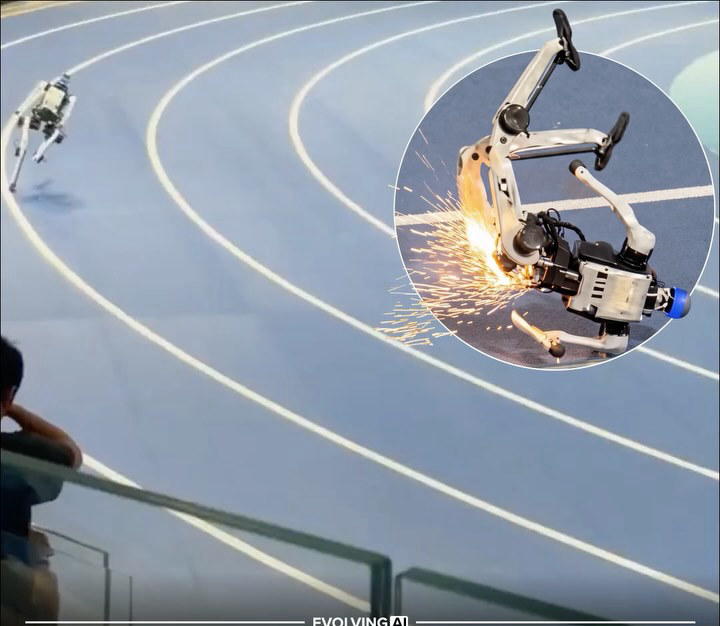
While several competitors at the event posted sprint times that surpassed baseline human benchmarks, the showcase was defined by frequent, violent collisions. Across track events and robot football matches, machines struggled to manage their own inertia, often failing to slow down after reaching maximum velocity.
Mechanical failures surfaced well before the official heats commenced. During training sessions, multiple units lost balance and veered off designated paths, including instances where platforms struck safety barriers and perimeter electrical infrastructure at full operational speed.
Acceleration Outpaces Control Loops
The contrast illustrates a central tension in modern robotics development. Advances in high-torque actuators and reinforcement learning policies have made high-speed linear locomotion relatively accessible, but synthesizing real-time sensory feedback to execute controlled stops on varied surfaces remains difficult.
For engineers aiming to deploy bipedal humanoids into commercial logistics and factory settings, predictable braking is vastly more important than peak sprinting ability. A heavy metal chassis unable to stop reliably under its own momentum poses immediate safety risks in human-occupied workspaces.
While the tournament produced a steady stream of hardware damage and physical wipeouts, the open-format trials serve as an aggressive stress test, revealing precisely where simulation-trained locomotion models continue to fail in the physical world.
Reporting based on coverage from @evolving.ai on Instagram.