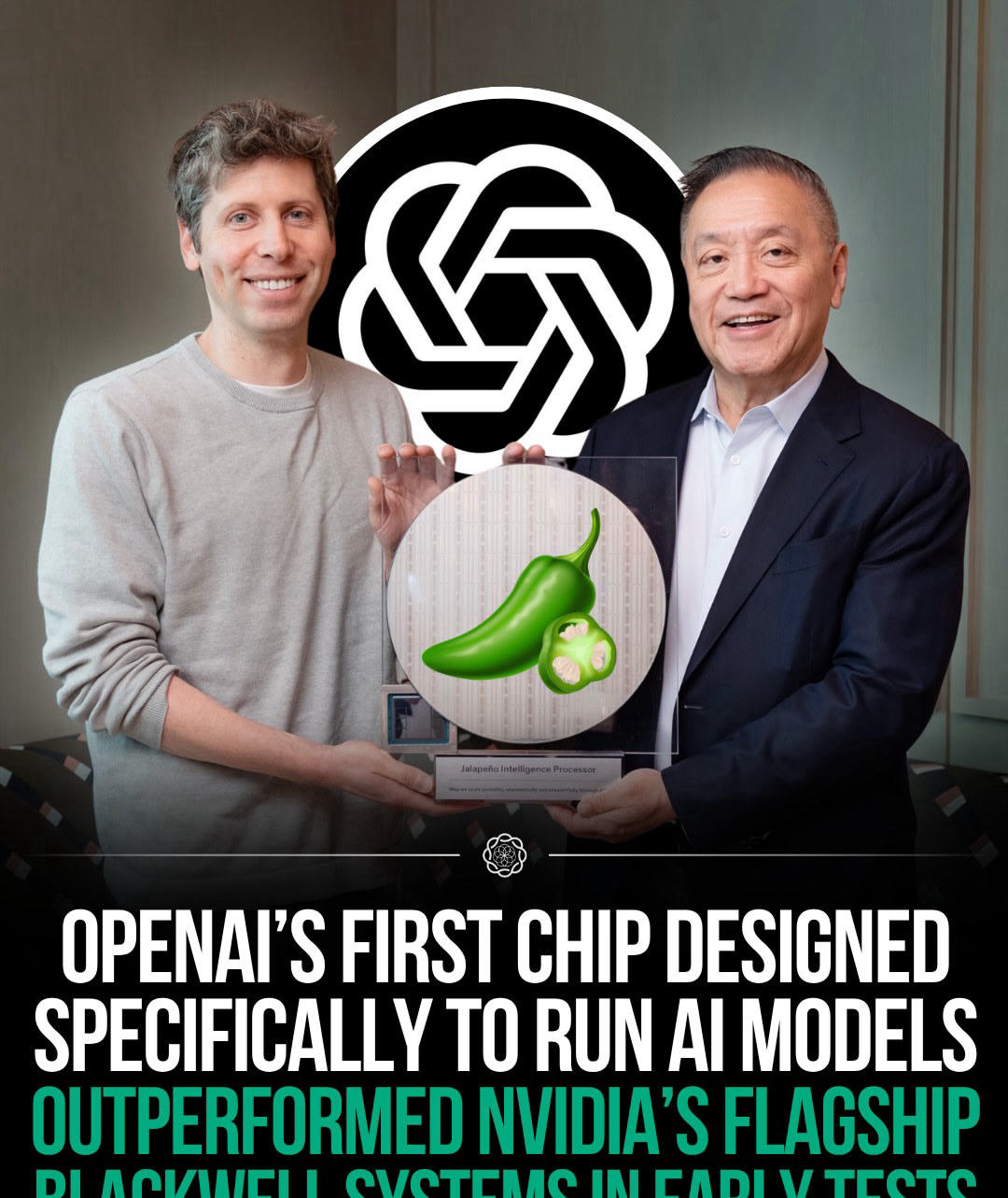
OpenAI Tests First In-House Inference Silicon, Claiming Efficiency Edge Over Nvidia Blackwell
Preliminary metrics for the custom processor, code-named Jalapeño, show up to a 90% boost in power efficiency during model execution.
Key highlights · 2 min read
- OpenAI has shared initial benchmark figures for its inaugural custom silicon, code-named Jalapeño, marking the AI developer's first concrete public step toward fielding in-house accelerator hardware.
- Engineered strictly for inference - the workload associated with serving live queries rather than training foundation models - the chip outperformed Nvidia's flagship Blackwell platform across seve…
- The architectural focus on power efficiency highlights the escalating economic pressure on frontier AI labs.
 The Scale Report
OpenAI has shared initial benchmark figures for its inaugural custom silicon, code-named Jalapeño, marking the AI developer's first concrete public step toward fielding in-house accelerator hardware.
Engineered strictly for inference - the workload associated with serving live queries rather than training foundation models - the chip outperformed Nvidia's flagship Blackwell platform across several test suites. Most significantly, OpenAI reported that Jalapeño delivered as much as 90 percent more computational throughput per unit of power consumed.
Targeting the Inference Bottleneck
The architectural focus on power efficiency highlights the escalating economic pressure on frontier AI labs. While training grabs headlines, the day-to-day cost of running deployed models across hundreds of millions of users now represents the bulk of ongoing operational expenditures.
Electricity availability has emerged as a primary ceiling on data center expansion worldwide. By squeezing nearly double the output from existing power envelopes, internal silicon could fundamentally alter the unit economics of operating services like ChatGPT, insulating OpenAI from regional grid constraints and steep third-party hardware margins.
The Silicon Reality Check
Substantial qualifiers remain around the early numbers. Jalapeño is not designed to replace general-purpose training clusters, meaning OpenAI will continue to depend heavily on Nvidia and merchant silicon providers to build its future frontier models.
Furthermore, transitioning from isolated laboratory benchmarks to stable, mass-manufactured chips running in production infrastructure is notoriously difficult. How quickly Jalapeño can be fabricated at scale, integrated into server racks, and supported with a robust compiler toolchain will ultimately determine whether OpenAI's hardware ambitions pose a genuine commercial threat to established chipmakers.
Reporting based on coverage from @chatgptricks on Instagram.