Tiangong Omni Clinches 400-Meter Robot Sprint with RL-Derived Running Gait
The humanoid completed the Beijing track event in 45.66 seconds after self-optimizing a defensive posture to reduce thermal and structural strain.
Key highlights · 2 min read
- At the World Humanoid Robot Games in Beijing, a small-stature humanoid called Tiangong Omni took first place in the 400-meter sprint category, crossing the finish line in 45.66 seconds.
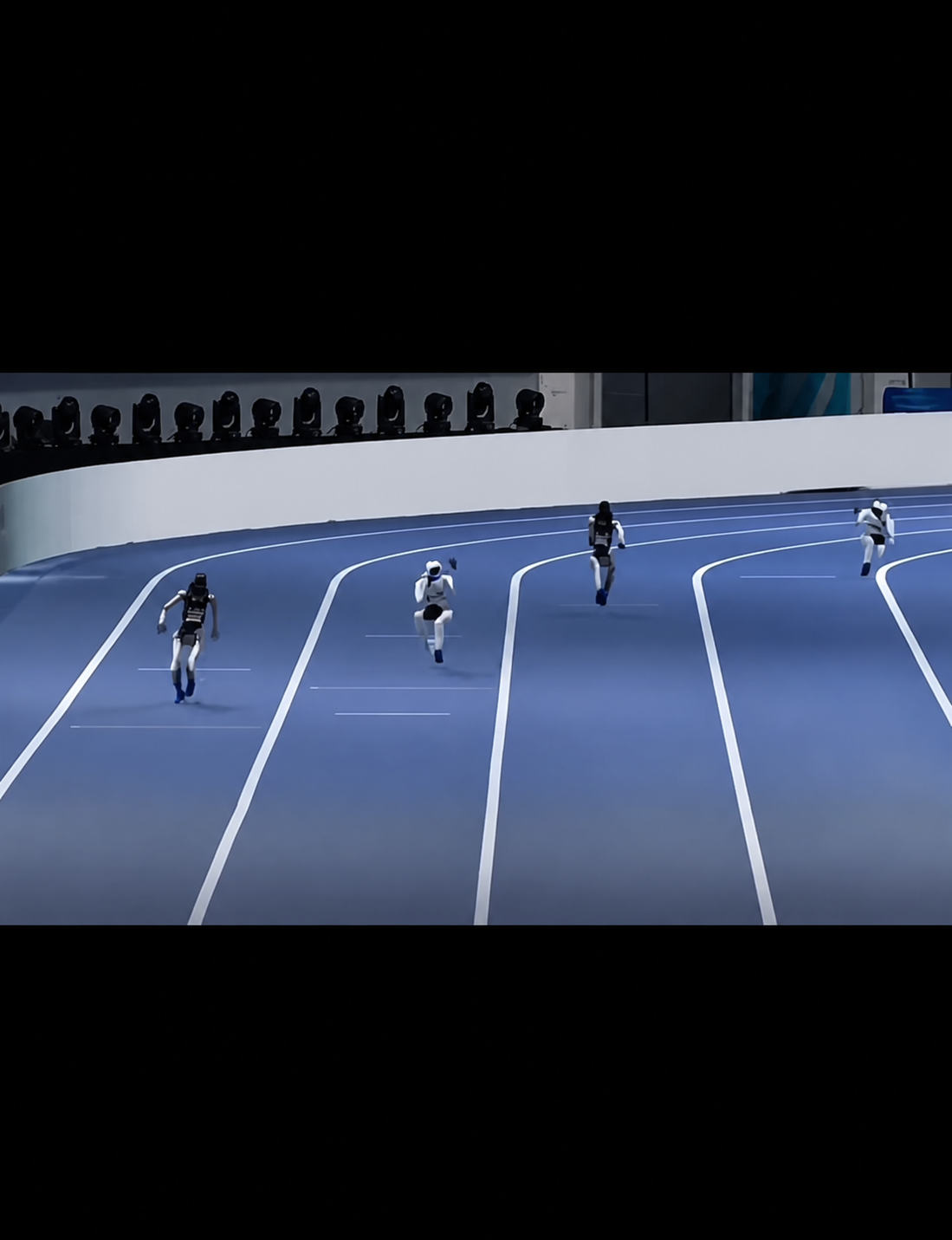
- During the sprint, Tiangong Omni maintained an aggressive forward tilt while keeping its arms tightly tucked inward over its face.
- According to technical details from the development team, the locomotion strategy was not hand-coded by human engineers.
 The Scale Report
At the World Humanoid Robot Games in Beijing, a small-stature humanoid called Tiangong Omni took first place in the 400-meter sprint category, crossing the finish line in 45.66 seconds. While the completion time set a benchmark for its class, the machine's distinct, non-human running posture drew significant attention from observers.
During the sprint, Tiangong Omni maintained an aggressive forward tilt while keeping its arms tightly tucked inward over its face. The unorthodox gait differed sharply from traditional biomimetic running profiles, which typically emulate human arm-swing dynamics for momentum counterbalancing.
According to technical details from the development team, the locomotion strategy was not hand-coded by human engineers. Instead, the behavior emerged organically through reinforcement learning algorithms tasked with maximizing sprint velocity within specific physical constraints.
Algorithmic Optimization vs. Human Form
The training pipeline prioritized system longevity alongside speed. By shielding its upper chassis and pulling its extremities close to its center of mass, the model discovered that it could minimize torque-induced strain on joint actuators while dampening thermal buildup across its motors. The pronounced forward lean simultaneously helped the hardware stabilize its center of gravity at continuous high speeds.
The result highlights a recurring pattern in reinforcement learning applied to dynamic robotics: when algorithms are freed from biomimetic motion priors, they routinely converge on counterintuitive mechanics. Because synthetic actuators and gearboxes do not share the exact elastic energy-storage properties of human muscle and tendon networks, optimal robotic locomotion often departs radically from human biology.
As competitive humanoid robotics continues to test autonomous locomotion under real-world track conditions, such performance-driven adaptations illustrate how machine-discovered gaits are beginning to prioritize hardware efficiency over visual anthropomorphism.
Reporting based on coverage from @evolving.ai on Instagram.