
Beijing Medical Resident Uses AI to Produce Candidate Proof for Decades-Old Math Conjecture
A 16-hour autonomous session with OpenAI's system yielded a potential solution to Crouzeix’s Conjecture, a matrix theory problem unsolved since 2004.
Key highlights · 2 min read
- A potential breakthrough on a long-standing mathematical problem has emerged from an unlikely quarter: a medical resident with no specialized background in pure mathematics, working alongside an ar…
- Shanmu Jin, a neurosurgery resident based in Beijing, generated a candidate proof for Crouzeix’s Conjecture after initiating a 16-hour automated session using GPT-5.6 Sol within ChatGPT Work.
- Jin did not set out to tackle abstract algebra.
 The Scale Report
A potential breakthrough on a long-standing mathematical problem has emerged from an unlikely quarter: a medical resident with no specialized background in pure mathematics, working alongside an artificial intelligence reasoning system.
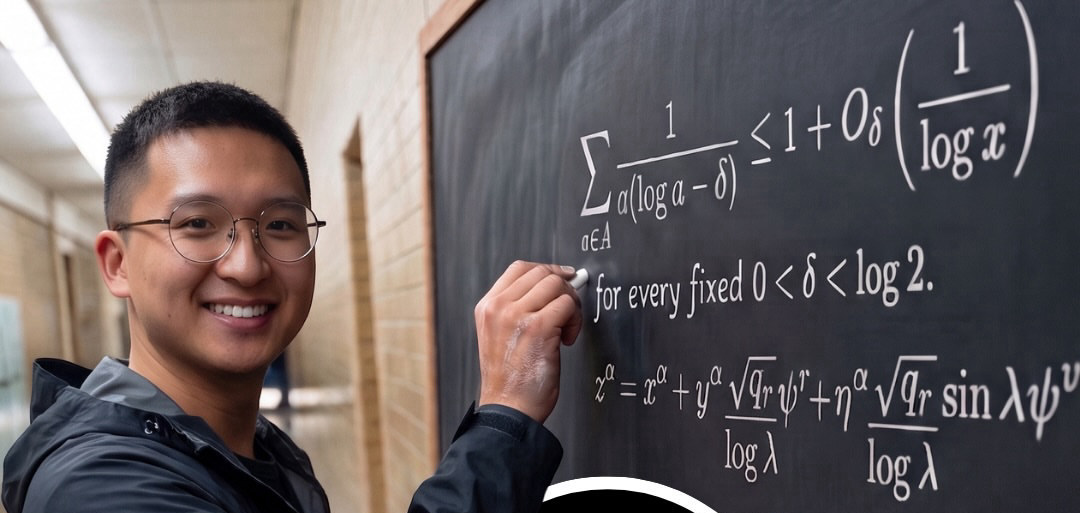
Shanmu Jin, a neurosurgery resident based in Beijing, generated a candidate proof for Crouzeix’s Conjecture after initiating a 16-hour automated session using GPT-5.6 Sol within ChatGPT Work. The conjecture, formulated in 2004, is a notable unsolved question in numerical linear algebra concerning matrix behavior and operator theory.
From Clinical Imaging to Pure Mathematics
Jin did not set out to tackle abstract algebra. His investigation began during technical research into brain ultrasound imaging, which eventually required grappling with complex numerical linear algebra. Lacking advanced academic training in the discipline, Jin turned to AI tooling to navigate the mathematical roadblocks.
During the uninterrupted 16-hour run, the model autonomously explored multiple theoretical proof trajectories while validating intermediate logical steps. The process concluded with a structured candidate proof, which has since been shared for broader academic examination.
Validation and the Broader Context
While the mathematics community has yet to formally verify the validity of the derivation, the milestone underscores how frontier reasoning models are lowering barriers to entry in specialized technical domains. Peer review in theoretical mathematics is rigorous, and candidate proofs frequently require months of scrutiny to uncover subtle invalid assumptions.
Even so, the episode highlights a notable shift in scientific tooling. As autonomous reasoning systems gain the capacity to execute extended, self-correcting logic loops, researchers outside core mathematical fields can increasingly explore and formulate hypotheses in previously inaccessible theoretical domains.
Reporting based on coverage from @chatgptricks on Instagram.


