
Beijing Medical Resident Uses Autonomous AI Run to Tackle 22-Year-Old Math Conjecture
A 16-hour session with GPT-5.6 Sol produced a candidate proof for Crouzeix’s Conjecture, an open problem in numerical linear algebra.
Key highlights · 2 min read
- A candidate proof for Crouzeix’s Conjecture, an unresolved problem in numerical linear algebra dating back to 2004, has emerged from an unexpected source: a Beijing medical resident directing an ex…
- Shanmu Jin, a neurosurgery resident investigating brain ultrasound applications, encountered complex matrix theory challenges during his clinical research.
- The AI system executed an autonomous session lasting roughly 16 hours.
 The Scale Report
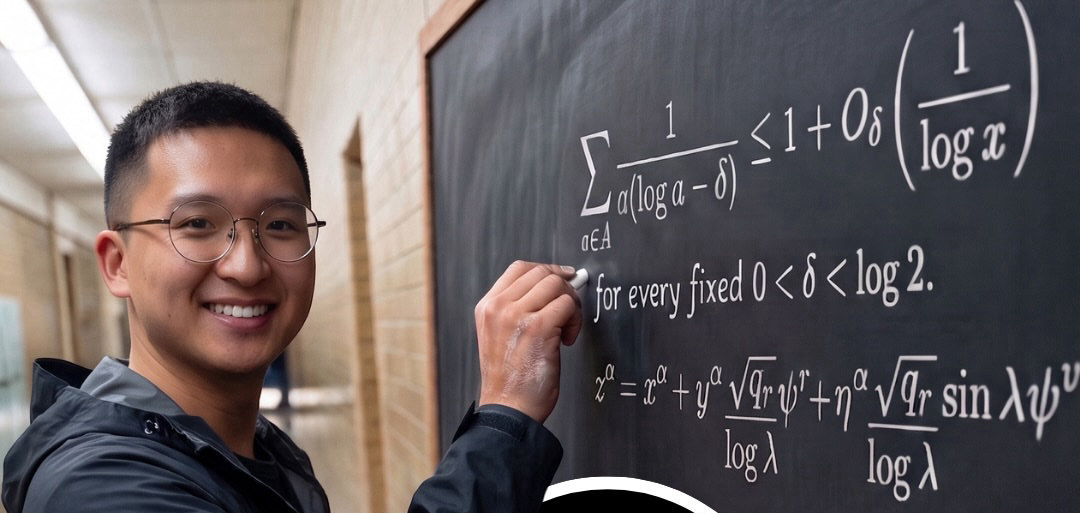
A candidate proof for Crouzeix’s Conjecture, an unresolved problem in numerical linear algebra dating back to 2004, has emerged from an unexpected source: a Beijing medical resident directing an extended autonomous artificial intelligence session.
Shanmu Jin, a neurosurgery resident investigating brain ultrasound applications, encountered complex matrix theory challenges during his clinical research. Despite having no advanced formal training in theoretical mathematics, Jin turned to OpenAI's GPT-5.6 Sol model within ChatGPT Work to explore the mathematical roadblock.
Autonomous Exploration
The AI system executed an autonomous session lasting roughly 16 hours. Over the course of the run, the model generated alternative proof pathways, tested intermediate logical steps, and evaluated its own outputs before finalizing a complete candidate proof for the 22-year-old matrix problem.
Crouzeix’s Conjecture concerns matrix behavior, specifically proposing an upper bound on the norm of a polynomial applied to a matrix relative to the supremum norm of the polynomial on the field of values. While mathematicians have established partial bounds and special cases over the last two decades, a definitive general proof has eluded domain experts.
The findings, initially shared on GitHub and reported by the South China Morning Post, represent a notable instance of reasoning-focused models executing multi-step mathematical arguments without real-time human intervention. However, the candidate proof must still undergo rigorous scrutiny and formal peer review by the mathematical community to ensure it contains no subtle reasoning flaws.
The development illustrates how frontier reasoning models are lowering the technical barrier to pure mathematics, enabling non-specialists to formulate sophisticated theoretical arguments that previously required decades of specialized domain expertise.
Reporting based on coverage from @chatgptricks on Instagram.


