
MIT System Uses AI and Muscle Stimulation to Directly Actuate Human Hands
The Media Lab’s 'Human Operator' project translates visual data and spoken prompts into electrical pulses that move a user's fingers and wrist.
Key highlights · 2 min read
- Researchers at the MIT Media Lab have built an experimental system that allows artificial intelligence models to physically guide a person's hand in real time, moving past traditional screen-based…
- Dubbed Human Operator, the project pairs computer vision and large language models with electrical muscle stimulation (EMS) hardware.
- The software pipeline relies on Anthropic's Claude API to interpret spoken voice instructions from the user alongside live visual input from an onboard camera.
 The Scale Report
Researchers at the MIT Media Lab have built an experimental system that allows artificial intelligence models to physically guide a person's hand in real time, moving past traditional screen-based visual instructions.
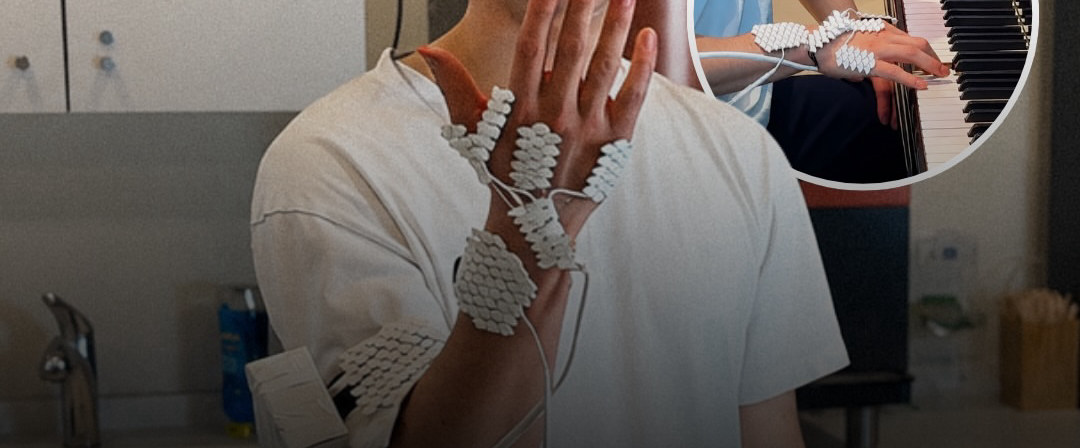
Dubbed Human Operator, the project pairs computer vision and large language models with electrical muscle stimulation (EMS) hardware. By sending targeted electrical currents to muscles in the forearm, wrist, and fingers, the system physically induces the precise motor actions required to complete a physical task.
Natural Language to Motor Control
The software pipeline relies on Anthropic's Claude API to interpret spoken voice instructions from the user alongside live visual input from an onboard camera. The model analyzes the scene, determines the physical steps needed to fulfill the request, and maps those actions into machine-executable movement signals.
Instead of outputting text responses or augmented reality overlays, the system dispatches coordinated micro-shocks to the user's motor nerves, prompting their hand to grip, twist, or reposition objects automatically.
MIT researchers frame the project as an exploration of human augmentation, intended to lower the barrier for learning complex manual tasks or to assist users with fine motor execution that they could not manage independently.
Shifting Agency from Screen to Body
While electrical muscle stimulation has been widely explored in physical rehabilitation and laboratory haptics for decades, coupling it with multimodal foundation models marks a notable shift in how humans interact with generative systems. Giving an AI model direct physical agency over human musculature bypasses human reaction time and cognitive processing entirely, but it also raises immediate practical challenges regarding calibration across different body types, mechanical safety thresholds, and user comfort.
Reporting based on coverage from @eluna.ai on Instagram.


